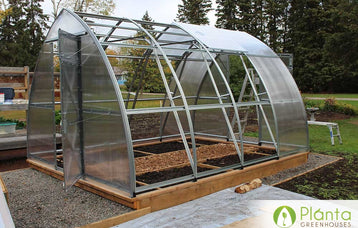
What base should my greenhouse sit on?

Best Greenhouse Base Ideas: How to Build a Strong Base for Any Greenhouse
What base should my greenhouse sit on?
Timber perimeter base · gravel interior · the most common DIY build
A greenhouse base improves stability, protects against freeze–thaw movement, and keeps the frame and panels out of standing water.

6 Greenhouse Base Types

Ordered roughly from easiest to hardest to build. Most backyard growers end up with one of the first two — or a combination of wood and gravel.
1. Wooden base
DIY FAVOURITE
1. Wooden base
Cost-effective and adaptable. Adjustable in height, so it forgives sloped or uneven ground, and it takes gravel or soil inside.
2. Concrete base
MOST DURABLE
2. Concrete base
The permanent option, and the one we would pick in high wind or heavy snow. Available as a full slab or a perimeter footing.
3. Stone base
LONGEST LIFE
3. Stone base
Durable and good-looking — the choice for permanent garden structures and raised greenhouse designs.
4. Tile or paving base
CLEAN FLOOR
4. Tile or paving base
Paving stones or patio tiles give you a base and a finished floor in one, without pouring concrete.
5. Gravel base
BEST DRAINAGE
5. Gravel base
The most practical DIY base, and the best answer to a wet site. Usually built inside a timber or metal perimeter frame.
6. Soil base
LOWEST COST
6. Soil base
The simplest and cheapest option: plant straight into native soil. Best for small or temporary installations.

Which base is best for you?

It comes down to four things: your climate, the size of the greenhouse, your budget, and whether this is permanent or a DIY build you might move.
DURABILITY
Concrete
Best wind resistance and the least movement over decades.
DIY BUILD
Wood or gravel
A timber perimeter filled with compacted gravel is the best all-round DIY base.
DRAINAGE
Gravel
Water passes straight through — no standing moisture, no mud.
APPEARANCE
Stone or tile
Worth the extra labour if the greenhouse sits in view of the house.
BUDGET
Soil or wood
Lowest cost to get growing this season, with the trade-offs above.
Which base is best for you?

Before you decide, check five things on site: sun exposure, soil and drainage, climate, ground level, and your anchoring materials. Whatever base you choose, it must be level, square and securely anchored before the frame goes up.

Do you actually need a base?

A base is optional on every Planta greenhouse. Here is what it buys you.
WHAT'S INCLUDED
Galvanized steel legs
Every Planta greenhouse ships with legs that extend about one foot into the ground. They anchor the structure, but in colder regions they usually do not reach frost depth.
WHY ADD A BASE
Freeze–thaw protection
A base protects the structure from ground movement as soil freezes and thaws, improves wind and snow-load performance, and reduces long-term shifting or settling.
HOW LONG IT LASTS
Up to 70 years of frame
Our heavy-duty galvanized frames are rust- and dust-resistant and can last decades depending on soil conditions. A proper base is what protects that investment.
Owner tending peppers inside her greenhouse

Speak With a Specialist

If you're not sure which base your site needs, get in touch with River, our greenhouse specialist. She will help you review options and make an informed decision.
Call 1-877-669-1286
Available from Monday to Friday, 9am–5pm EST

Building a base on uneven ground or a slope

  1. 01

    Use a raised or stepped perimeter base rather than regrading the whole site.

  2. 02

    Level the base, not the entire yard — adjust height with timber, block, stone or gravel.

  3. 03

    Compact the sub-base thoroughly and add landscape fabric under gravel.

  4. 04

    Square the base by measuring both diagonals before any frame goes up.

  5. 05

    Anchor securely, and size the base for the longest house you might extend to.

Common base questions

No — a base is optional on every Planta greenhouse. The galvanized legs extend about a foot into the ground and will hold the structure on their own. A base is what protects it from freeze–thaw movement, improves wind and snow-load performance, and stops long-term settling.

A timber perimeter filled with compacted gravel. It is the best all-round DIY base: adjustable in height so it forgives uneven ground, quick to build, and it drains well.

Concrete. It gives the best wind resistance and the least movement over decades. You can pour a full slab or just a perimeter footing — the footing is cheaper and still lets you plant in the ground inside.

Gravel. Water passes straight through, so there is no standing moisture and no mud. Lay landscape fabric under the gravel and compact the sub-base thoroughly.

Yes. Use a raised or stepped perimeter base and level the base rather than regrading the whole yard — adjust the height with timber, block, stone or gravel.

Level and square before any frame goes up — measure both diagonals and adjust until they match. Building on an out-of-square base makes the frame and panels difficult to fit.

Yes, with a wooden, gravel or perimeter-footing base — all three leave the soil inside open. A full concrete slab does not, so choose a perimeter footing if in-ground beds matter to you.

Yes. Extensions come in 6.5 ft sections, and redoing the base work later costs far more than building it longer once. Size the base for the longest house you might extend to.

What owners say about their base

2,400 reviews · 4.8 average
Sigma Urban install
★★★★★Wooden base
“Timber frame, crushed stone inside. Two weekends of work and four winters later it hasn't moved.”
Marta L. · Oregon
Sungrow 20 install
★★★★★Gravel base
“Gravel was the right call on our wet corner — no standing water, even in April.”
Dana R. · Vermont
Sigma 13 install
★★★★★Concrete base
“We poured a concrete perimeter instead of a full slab. Cheaper, and I can still plant in the ground.”
Kevin P. · Michigan
Sigma 20 install
★★★★★Soil base
“Set it on bare soil the first year. It sank at one corner, so we rebuilt on a timber base.”
Alicia M. · Ontario
Everest 13 install
★★★★★Tile base
“Paving slabs on compacted gravel. Clean floor, easy to sweep, nothing shifting underfoot.”
Tom & Sue B. · Colorado
Terra 27 install
★★★★★Stone base
“Stone base was a lot of labour, but it looks like it belongs in the garden and it holds heat.”
Rosa V. · New York
The Beginner's Guide for Greenhouse Owners
New to greenhouses?

Get The Beginner's Guide for Greenhouse Owners

Learn how to choose and setup your greenhouse. Enter your email to receive this guide and join our community of over 25,000 happy greenhouse owners.


Need help to choose a greenhouse base?
Speak with River, our greenhouse specialist. Mon–Fri, 9am–5pm EST.
Call 1-877-669-1286